An office in Nagpur needs battery backup only when a power interruption can stop essential systems for longer than the business can tolerate. By measuring the critical load, required runtime and acceptable transfer time, you can decide whether you need an inverter battery, a complete inverter, an online UPS or no battery system at all.
Key takeaways
- Review three to six months of outage duration before buying backup equipment.
- Use an inverter battery for basic backup; choose an online UPS for sensitive loads.
- Calculate battery capacity from load, backup time, system voltage and inverter efficiency.
- Demand test reports, warranty terms, battery dates and service commitments from suppliers.
When does a Nagpur office actually need battery backup?
Choosing an inverter battery for office in Nagpur starts with outage evidence, not floor area. Review MSEDCL interruption logs and your office log for the last three to six months: count outages, record each duration, and note whether failures cluster during monsoon, peak summer demand or local maintenance.
Compare the longest usual outage with your acceptable downtime. A two-minute interruption can corrupt a server session, reboot a network switch or disable biometric and access-control systems, while staff may tolerate twenty minutes without general lighting.
| Load group | Keep on battery? | Reason |
|---|---|---|
| Routers, network switches, servers and VoIP equipment | Yes | Preserves connectivity, sessions and communications |
| Biometric devices, CCTV, access control and fire panels | Yes | Maintains entry records, surveillance and safety functions |
| Air conditioners, heaters and pantry appliances | No | High consumption with limited continuity value |
| Printers and general lighting | Usually no | Work can pause; lighting outage is less damaging than IT failure |
Measure the essential circuit’s actual watts and kVA, then specify runtime for that load alone. A ten-minute UPS may cover orderly shutdown or generator changeover; a two-hour requirement demands a different battery bank. Do not assume a larger inverter supplies longer backup: inverter output capacity and battery energy are separate.
If outages exceed your tolerance, or a single short interruption affects revenue, security or safety, battery-backed UPS protection is justified. If only lighting stops and operations resume without data loss, a battery system may not be worth the cost.
Do you need an inverter battery, a complete inverter or an online UPS?
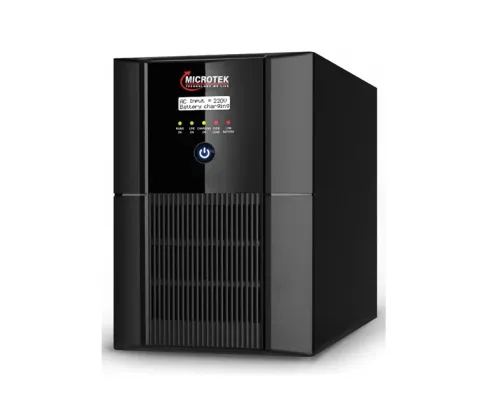
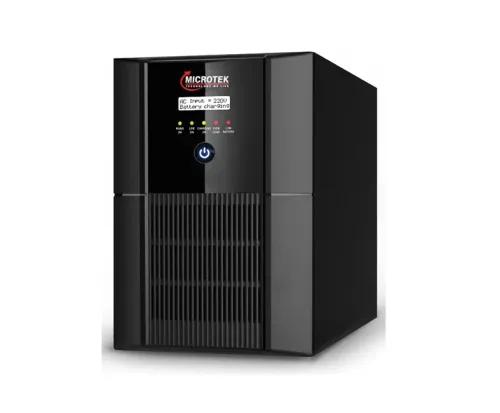
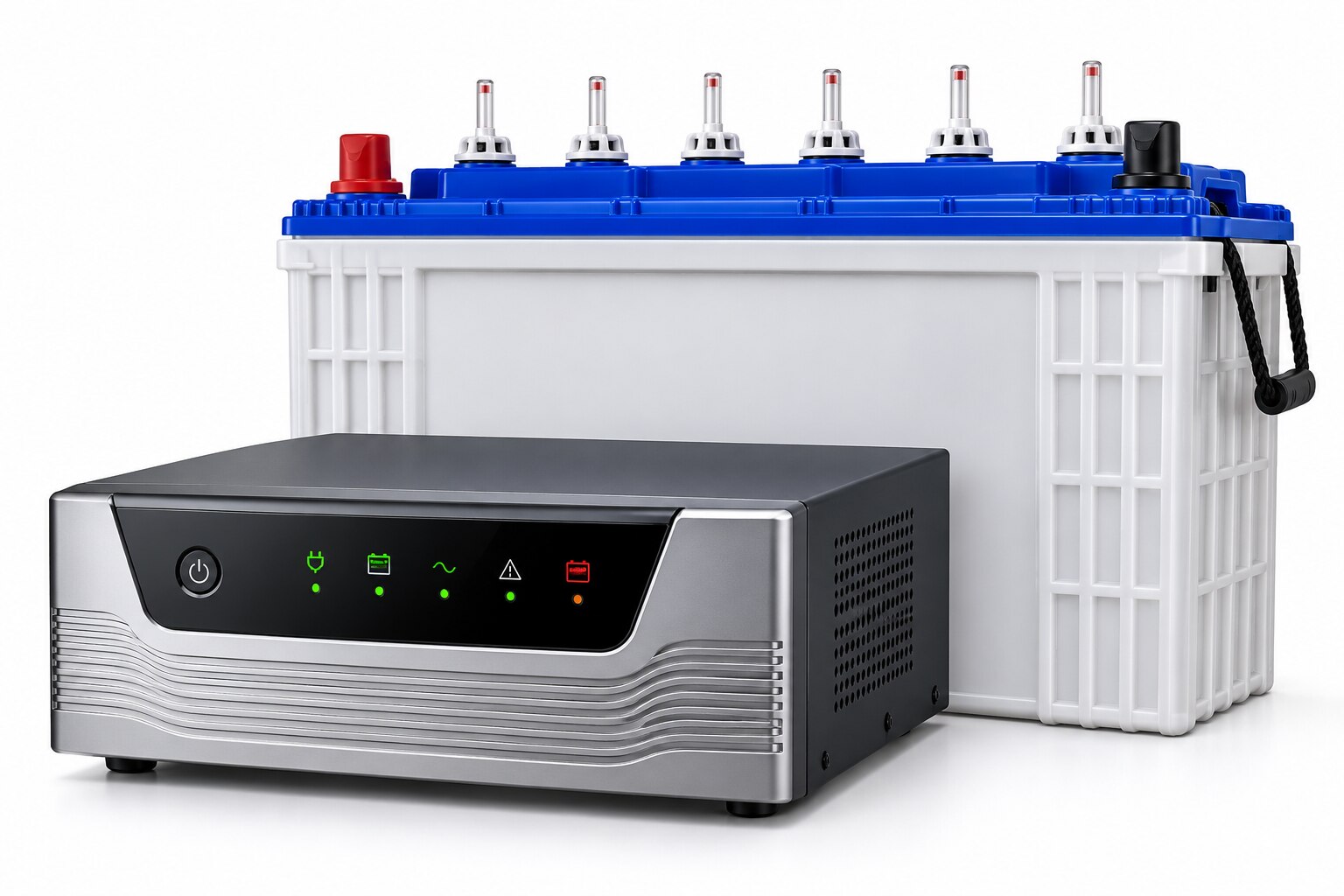
Choose a battery for stored energy, an inverter for DC-to-AC conversion, and a UPS when equipment needs automatic transfer and protection. The battery stores energy as DC; it does not produce usable AC by itself. A complete inverter combines the inverter, charger, changeover controls and protection in one system.
For anyone searching inverter battery explained in Nagpur, the key distinction is energy backup versus power quality. A battery will not correct poor earthing, neutral faults or harmonic distortion, and increasing battery VA does not create longer runtime. Match both the load’s kW and kVA, power factor, overload requirement and required runtime.
| Option | Output and conditioning | Transfer behaviour | Best fit |
|---|---|---|---|
| Battery only | DC storage; no AC output or regulation | No transfer function | Systems with a separate compatible inverter or UPS |
| Complete inverter | Converts DC to AC; includes charging and controls | Changeover depends on design | General office loads needing backup |
| Standby or line-interactive UPS | AC output with some regulation and protection | Transfer interval can occur; conditioning is limited | Non-critical computers and short interruptions |
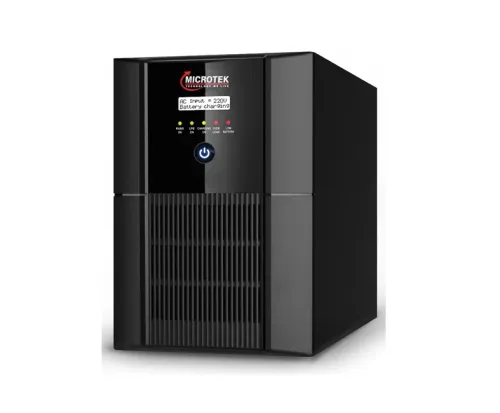
| Online double-conversion UPS | Continuously converts AC to DC and back to AC; stable waveform and voltage | Effectively no transfer-time interruption | Servers, network equipment and sensitive IT loads |
Check the output waveform, voltage regulation, overload rating and power factor, not only the VA label. A larger VA rating carries more load; it does not extend runtime. For a 10–30 minute computer backup, a high-rate VRLA UPS battery may suffice.
Two to eight hours requires a compatible larger battery bank, and lithium-ion needs its own battery-management, charger and thermal-protection compatibility.
How do you calculate the battery size and backup runtime?
Use this working formula:
Battery capacity (Ah) ≈ load (W) × backup time (hours) ÷ (DC bus voltage × inverter efficiency × permitted depth of discharge).
For a 1,000 W load running for two hours on 48 V, at 90% efficiency and 80% usable discharge: 1,000 × 2 ÷ (48 × 0.9 × 0.8) = about 58 Ah. Add capacity for ageing, high temperature, cable loss and the manufacturer’s discharge curve.
| Term | What it means | Why it matters |
|---|---|---|
| Watt-hours | Energy consumed: watts × hours | Determines stored energy required |
| Ampere-hours | Charge delivered at a stated discharge rate | Nominal Ah is not fully usable |
| Usable capacity | Rated capacity within the permitted discharge limit | Protects battery life |
| DC voltage | Battery-bank voltage, such as 48 V | Higher voltage reduces current for the same load |
Measure the actual running load rather than adding device labels. Record:
- Desktop computers and monitors
- Routers, switches and other networking equipment
- A small server
For example, four desktops with monitors might draw less than their combined nameplate rating, while a server’s starting or operating demand can change the total. A plug-in power meter or UPS load reading gives better data.
Inverter output capacity and battery energy are different. The inverter’s kW or kVA rating determines what it can carry; the battery bank’s kWh determines how long it runs. Power factor links them: VA equals watts divided by power factor.
Runtime falls as load rises and batteries age, so use the manufacturer’s constant-power discharge table instead of multiplying nominal Ah by claimed runtime.
How many batteries will the office need in Nagpur’s conditions?
A 10–30 minute UPS runtime usually needs one compact high-rate VRLA string, while two to eight hours requires a larger battery bank. The exact count comes from the inverter’s DC bus: connect batteries in series to reach its voltage, then use parallel strings to increase ampere-hour capacity.
For example, four 12 V batteries in series produce a 48 V string.
Add a parallel string only when the UPS charger, battery-management system and manufacturer-approved configuration support it. Every lead-acid battery in parallel must match in model, capacity, age and cable length; mixing old and new units causes unequal current sharing and premature failure.
| Option | Best fit | Main consideration |
|---|---|---|
| High-rate VRLA | 10–30 minutes for computers and networking | Compact, but heat shortens service life |
| Tubular lead-acid | Two to eight hours | Larger, ventilated installation and electrolyte maintenance |
| Lithium-ion | Repeated cycling or limited floor space | Requires a compatible BMS, thermal protection and approved charger |
Nagpur heat makes placement part of sizing. Lead-acid batteries are commonly rated at 25°C, and sustained higher temperatures accelerate grid corrosion, water loss and capacity ageing. Keep the bank ventilated and thermally controlled; avoid an unconditioned tin-roof room.
Check the installation for:
- Swollen cases, leakage, hot terminals and loose connections
- Abnormal float voltage and damaged cables
- Electrolyte level and water requirement in flooded batteries
- BMS alarms, thermal protection and charger compatibility in lithium systems
Never connect a lithium pack to a lead-acid inverter because the nominal voltage appears similar.
What should you demand from a commercial battery supplier?
A commercial inverter battery supplier in Nagpur should give you an engineered, documented configuration—not a battery price and a claimed runtime. Demand these items before approving the purchase:
1. A measured site load in watts and kVA, separated into essential and nonessential equipment, plus a written autonomy calculation showing the battery-bank voltage, inverter efficiency, permitted depth of discharge and ageing margin.
2. The exact battery model, chemistry, quantity, series-parallel arrangement and manufacturer discharge table for your required load and runtime. Nominal Ah alone cannot prove two hours of backup.
3. Charger output current and compatibility with the proposed bank. Adding a battery string without confirming the UPS charger, DC bus voltage and approved configuration can leave batteries permanently undercharged.
4. DC fuse or breaker ratings, accessible isolation and cable specifications. An AC-side MCB protects the AC circuit; it does not adequately interrupt a high-current fault inside the battery bank.
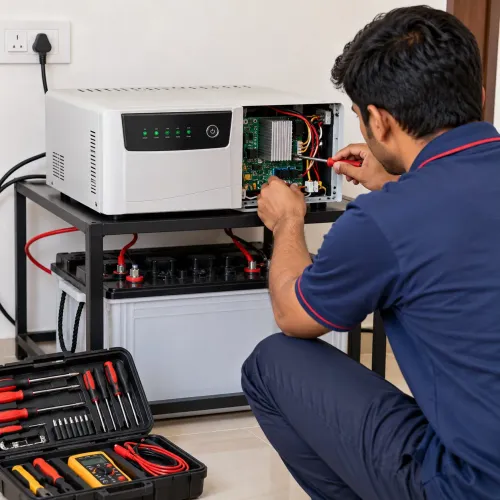
5. A rack or enclosure, terminal protection and a ventilation plan that matches the battery type. Flooded batteries need electrolyte access and controlled ventilation; VRLA and lithium installations still need inspection access and temperature management.
6. A commissioning record showing polarity, terminal torque, float voltage, alarms, load test and handover date; written warranty conditions, exclusions, response time and escalation contacts.
Test usable capacity periodically under a controlled discharge. The UPS percentage display is often an estimate based on voltage and charging history, not proof of remaining runtime.
Specify removal of spent batteries and obtain a handover or recycling record. The Battery Waste Management Rules, 2022 require covered batteries to enter an environmentally sound collection and recycling channel, not general scrap.
Mahendra power Zone can be compared for local supply, installation, rental or service when those documents and support terms are provided.
Related products
 | Inverter Battery Brand Exide Product Type Inverter Battery Color Red Use Electricity Backup Load Crest Factor 31 Country of Origin Made in India We MAHENDRA POWER... View product → |
 | Ups Battery Type Online Brand Eaton Usage/Application Industrial Protection OverVoltage Warranty 1 Year We MAHENDRA POWER POWER , leading supllier of UPS... View product → |
Frequently asked questions
When does a Nagpur office actually need battery backup?
You need battery backup when outages interrupt computers, internet equipment, security systems, billing, production or other essential work. Review MSEDCL interruption records and your office log for three to six months, recording outage frequency, duration and seasonal patterns.
Do you need an inverter battery, a complete inverter or an online UPS?
An inverter battery stores energy but cannot power equipment without a compatible inverter. Buy a complete inverter system when you need basic backup for general office loads. Choose an online UPS when computers, servers, networking equipment or medical and industrial electronics need continuous voltage regulation and zero transfer time.
How do you calculate the battery size and backup runtime?
Add the wattage of the equipment you will run, multiply it by the required backup hours, then account for inverter efficiency and usable battery capacity. Confirm the result against the inverter's DC voltage and the battery's ampere-hour rating before buying.
How many batteries will the office need in Nagpur's conditions?
The number depends on the inverter's DC bus voltage, total load, desired runtime and battery voltage. Nagpur's heat can shorten battery life, so keep batteries ventilated, away from direct sunlight, and within the manufacturer's temperature limits.
What should you demand from a commercial battery supplier?
Ask for a written load and runtime calculation, battery make and model, manufacturing date, test report, warranty exclusions, installation method, maintenance schedule, replacement terms and a defined service response time.
Keywords