Nagpur’s monsoon supply can combine feeder voltage dips, restoration surges, lightning transients, humidity and water-ingress risks. By the end, you will be able to match the stabilizer’s phase arrangement, kVA capacity, correction range and protection features to measured site conditions rather than choosing from a nominal 230 V or 415 V label.
Key takeaways
- Choose independent three-phase regulation for pumps, compressors and CNC machinery.
- Measure voltage during low-load, peak-load and post-restoration conditions before choosing range.
- Size kVA for motor starting current, power factor and planned equipment additions.
- Add surge protection, UPS support and moisture control for monsoon reliability.
Choose independent three-phase regulation for plant machinery
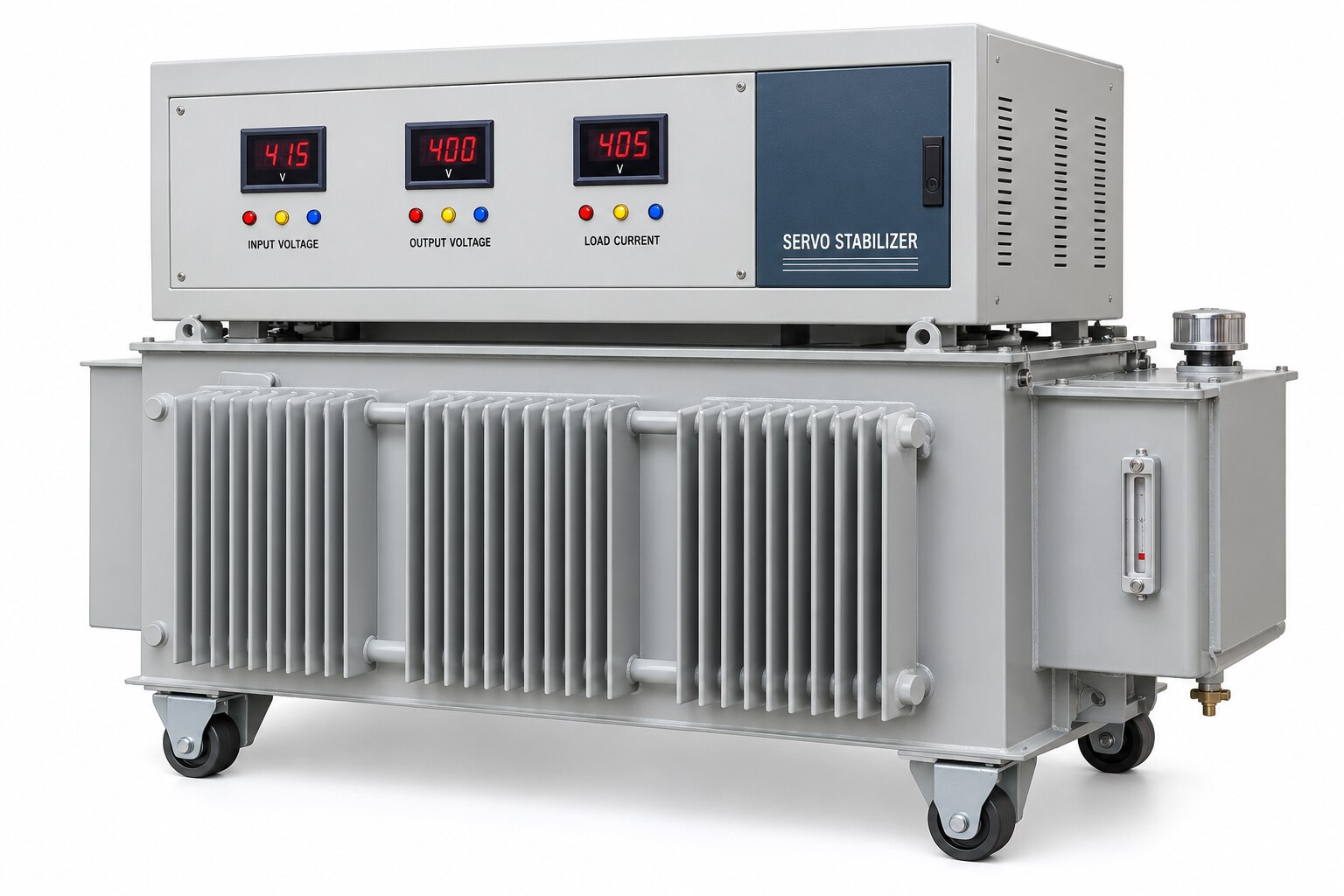
For pumps, compressors, CNC equipment, lifts and production lines, choose a three-phase, oil-free, motor-driven servo stabilizer with independent phase regulation. A servo stabilizer for monsoon in Nagpur must handle sustained under-voltage, over-voltage after feeder restoration, lightning-related transients, humidity and unstable utility supply.
Independent control matters because long feeders, uneven loading and single-phase loads can give each phase a different phase-to-neutral voltage.
| Option | Best fit | Limitation |
|---|---|---|
| Single-phase, 2 kVA | Home, small office or one individual machine | Use only with a single-phase load, suitable starting current and measured voltage inside its correction range |
| Three-phase common regulation | Balanced loads with similar phase voltages | One weak or heavily loaded phase can affect the regulated output |
| Three-phase independent regulation | Pumps, compressors, CNC equipment, lifts and production lines | Requires correct sizing, phase-wise sensing and planned maintenance |
An industrial stabilizer in Nagpur is required when the site has three-phase motors, phase imbalance, high starting current or one common supply feeding multiple machines. A 2 kVA single-phase unit is not a substitute: motor starting demand can overload it even when running power looks acceptable.
Record phase-to-neutral voltages during rain and feeder restoration before choosing; independent regulation prevents one phase’s disturbance from passing to the others, but it does not replace surge protection for lightning transients.
Measure the supply before selecting the input correction range
A voltage stabilizer for rainy season must match your measured site range, not nominal 230 V single-phase or 415 V three-phase supply. Use a true-RMS power-quality logger or calibrated meter, and record all three phase-to-neutral and phase-to-phase voltages across representative operating periods.
- Log readings during dry weather, heavy rain, feeder restoration, peak operating hours and generator operation.
- Record sustained minimum and maximum RMS voltage separately from brief dips, surges and transients. RMS variation determines correction range; a short motor-starting dip or lightning surge needs response testing and surge protection.
- Compare the record with the advertised range. A 170–270 V input range is inadequate if the incoming voltage falls below 170 V or rises above 270 V: the stabilizer may reach its correction limit, pass an uncorrected or out-of-tolerance voltage, or trip, depending on its control design.
- Select margin beyond both observed extremes and require output accuracy, correction rate, response to defined voltage steps, frequency range and performance during phase imbalance.
| Condition | What to record | Selection consequence |
|---|---|---|
| Dry and rainy utility supply | Phase-wise RMS minimum and maximum | Set correction limits beyond both values |
| Feeder restoration | Recovery surge and settling time | Check input tolerance and transient protection |
| Generator operation | Phase voltage, frequency and imbalance | Require documented generator compatibility |
This process identifies the right servo stabilizer for monsoon in Nagpur instead of choosing a wide-input label that fails at the site boundary. Ask for accuracy test conditions: input voltage, load percentage, power factor, temperature and phase balance.
Size kVA for starting current, power factor and future load
Size the stabilizer from maximum apparent power, not the simple sum of motor nameplate kW. Use kVA = kW ÷ power factor; a 100 kW load at 0.8 power factor requires 125 kVA before starting demand and growth allowance.
Prepare a load schedule for every motor, compressor, pump, transformer, VFD and UPS rectifier:
- Running kW and power factor
- Full-load current and starting current
- Starting sequence and simultaneous-operation requirement
Motors and compressors can draw several times their running current during startup. That surge can create a voltage dip even when the average load looks small.
Ask the supplier to verify overload duration, starting voltage dip, correction speed, and whether sequential starting, a soft starter or a VFD is needed. Add capacity for planned load growth, but do not treat an oversized unit as automatically safer: excess capacity can increase cost, losses and poor control at light load.
Compare published performance under identical conditions:
| Test condition | Why it matters | Require |
|---|---|---|
| Load percentage | Accuracy changes with loading | State the tested percentage |
| Power factor | Reactive current changes kVA and regulation | State the tested power factor |
| Temperature and phase balance | Heat and unequal phases affect output | State both conditions |
| Rapid load change | ±1% at steady load proves little during starting | Require response to a defined voltage step |
For an industrial stabilizer in Nagpur, obtain these figures in writing rather than relying on a ±1% brochure claim.
Combine voltage correction with storm and continuity protection
1. Choose the voltage stabilizer for rainy season by separating its job from protection equipment. A servo stabilizer corrects sustained RMS under-voltage and over-voltage; a static voltage stabilizer or automatic voltage regulator performs the same broad regulation function electronically.
Neither replaces a Type 1 or Type 2 surge protective device at the electrical installation, lightning protection, earthing, phase-failure or phase-sequence protection, a generator, or UPS battery backup.
2. Specify the protection schedule with the industrial unit: an SPD, phase-loss and phase-sequence relay where the equipment requires it, input and output MCCBs or fuses, overload and short-circuit protection, under-voltage and over-voltage trips, alarms or dry contacts, and an automatic maintenance bypass.
The bypass keeps production running while a servo motor or carbon brush is serviced.
3. An UPS maintains continuity; it does not provide galvanic isolation. Add an isolation transformer when galvanic isolation is required. Assess harmonics, neutral loading and electrical noise separately when VFDs, welders or rectifiers are present, because a servo stabilizer does not remove them.
4. Place a stabilizer before an online UPS only when measured utility or generator voltage falls outside the UPS input envelope, causes repeated transfer or derating, or violates the manufacturer’s input limits. Otherwise, the extra unit adds losses, maintenance and control-loop risk. Confirm this before buying a servo stabilizer for monsoon in Nagpur.
Specify a maintainable, moisture-controlled installation
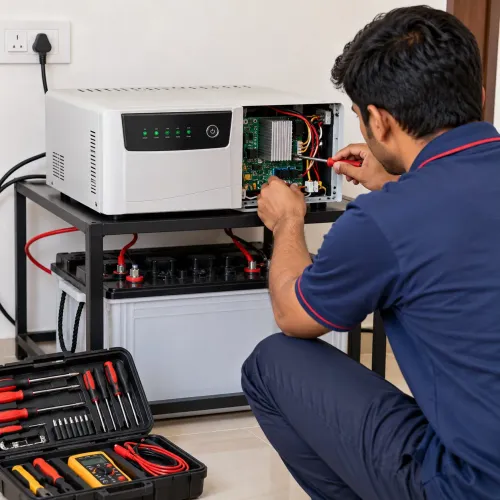
Install the stabilizer in a dry electrical room, not under a leaking roof or in an open yard. A raised plinth, sealed cable entries, floor drainage, a roof or drip canopy, and manufacturer-specified cooling clearances prevent monsoon water ingress and overheating.
| Rating | Water protection | Installation limit |
|---|---|---|
| IP54 | Dust-protected and protected against splashing water from any direction | Not permission for direct rain, standing water or roof leaks |
| IP55 | Dust-protected and protected against water jets | Still unsuitable for direct rain, flooding or a leaking room |
| Neither rating | Does not prevent internal condensation | Use anti-condensation heaters and controlled ventilation in a humid, non-air-conditioned room |
Use this purchase and installation checklist:
- Record the room’s drainage, plinth height, cable-entry seals, canopy and cooling clearances.
- Require inspection after heavy rain for moisture, corrosion, brush dust and tracking marks.
- Obtain written generator compatibility, acceptable frequency range, minimum generator load, control settings and bypass behaviour.
- Confirm automatic maintenance bypass, input/output MCCB or fuses, overload protection, under- and over-voltage trips, alarms and phase-failure protection.
- Ask for measured response to defined voltage steps, accuracy at stated load, power factor, temperature and phase balance.
- Verify that the AVR and servo loop will not hunt during generator transfer, light load or rapid load changes.
Choose a correctly sized, independently regulated three-phase unit with a verified site range rather than a larger, poorly specified model.
For a servo stabilizer for monsoon in Nagpur, Mahendra power Zone can assess the site, install or maintain the unit, and provide rental support; compare its written test conditions, protection schedule and service response with alternatives.
Related products
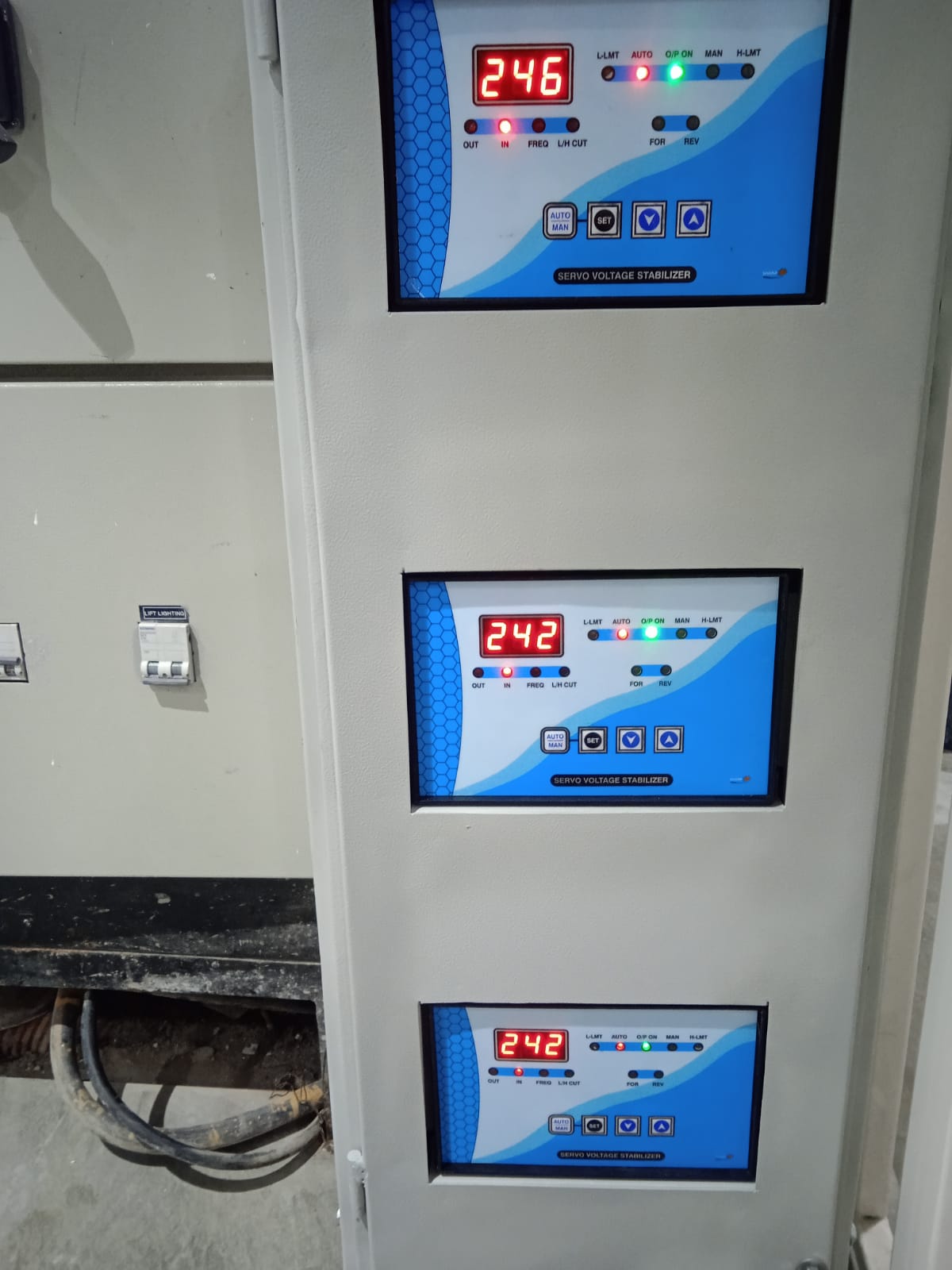 | Servo servo 3 kva to 500 kva View product → |
 | Servo Stabilizer Capacity (Kva) 2 KVA Phase Single Phase Input Voltage 170 to 270 V Body Material Steel Type Automatic Frequency (Hz) 50 - 60 Hz Matching up with the... View product → |
Frequently asked questions
Why choose independent three-phase regulation for plant machinery?
Independent regulation corrects each phase separately, helping protect pumps, compressors, CNC equipment, lifts and production lines from phase imbalance.
How do you select the input correction range for Nagpur monsoon?
Record supply voltage during peak demand, low-load periods and utility restoration, then choose a range covering the measured extremes.
How should you size a servo stabilizer in kVA?
Include running load, motor starting current, power factor and capacity for future equipment instead of sizing from running watts alone.
Does a servo stabilizer protect equipment from lightning and power interruptions?
No. Pair voltage correction with coordinated surge protection, earthing, storm protection and UPS or generator support for continuity.
What installation features improve monsoon reliability?
Use a dry, ventilated location with controlled moisture, accessible bypass and isolation, clearances for maintenance, and protection from water ingress.
Keywords